
Metallic inks are classical spot color inks. Their presence on the image are very important in packaging and label applications, as they help to attract attention of customers. Many high end products such as wines, cosmetics, etc. utilize metallic ink in packaging. There are many shade of metallic colors, from silver to gold and copper.
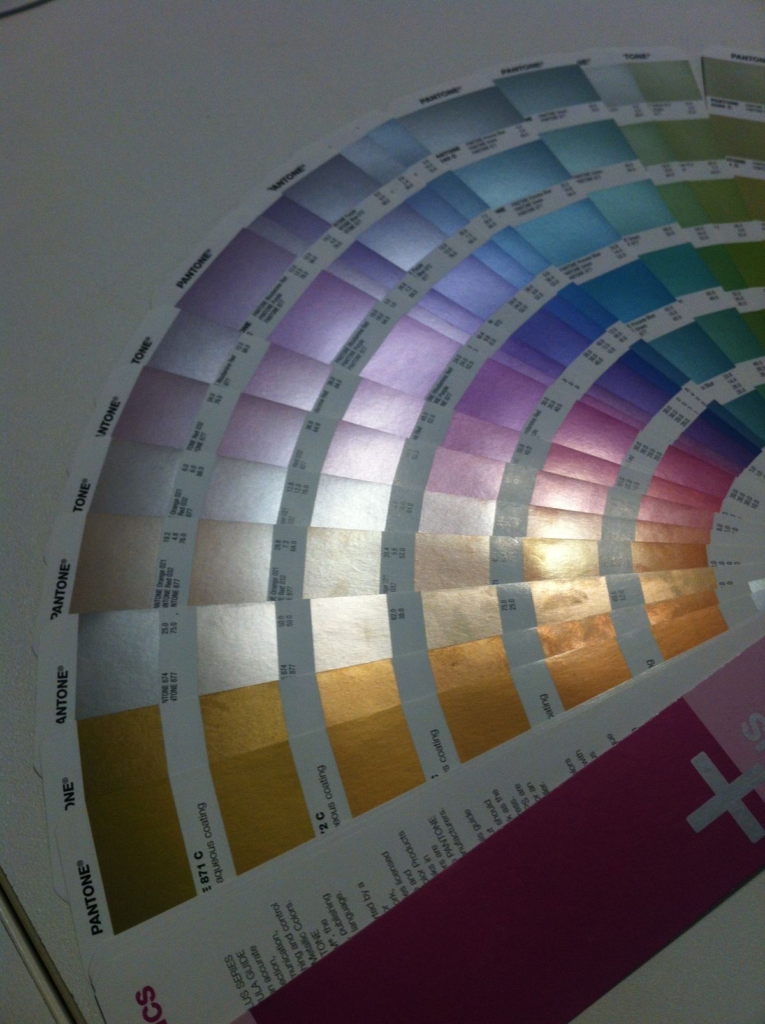
Pantone color samples for metallic inks are shown on this photo. For metallic inks, the color measurement is more difficult and requires special tools. The ‘flop index’ parameter is used to characterize the metallic sheen, which is a measure of their ability to reflect the light in specular direction.
Still another variety of metallic effect is seen in pearlescent inks. They have a much lighter sheen. There are different shades of pearlescent inks as well, from silver-gold to rainbow spectrum.
Metallic/pearlescent pigments act as small mirrors and reflect the light that falls down on them. It is essential for them to be flat in shape and to have a uniform surface. Metallic pigments are often made out of flattened aluminum flakes; pearlescent pigments are made out of flat crystals of mica covered with titania to increase the refractive index. A large particle size of several micrometers or more is essential for the metal pigments to work, otherwise they scatter light and loose metallic sheen.
Metallic inks are very difficult, in not impossible to implement in digital imaging. The pigment size is too big to be used in inkjet; in electrophotography, the high electrical conductivity of metallic pigments causes electrical failures. Because of this, the analogue printing (e.g., screen printing) is still very important technology for metallic inks.